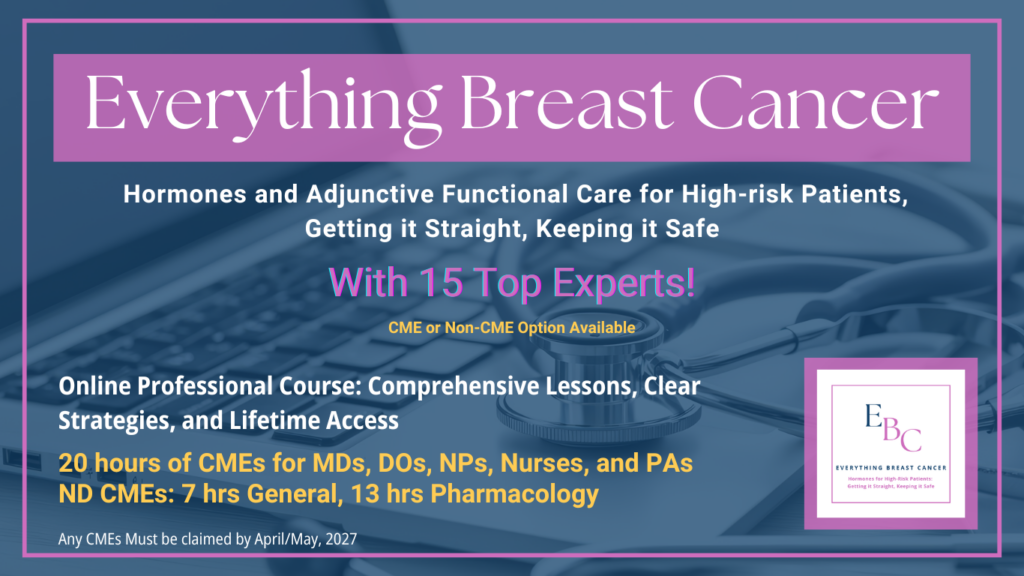
Everything Breast Cancer
Hormones and Adjunctive Functional Care for High-risk Patients,
Getting it Straight, Keeping it Safe
Online Course • Work at Your Own Pace
20 hours of CMEs for MDs, DOs, NDs, NPs, PAs, Nurses, and Pharmacists
CMEs must be claimed before May 31, 2027*
*NDs must claim by April 30, 2027
Featuring
*Dr. Xan Simonson * Dr. Thomas Seyfried * Dr. Daved Rosensweet * Carol Petersen, RPh, CNP * Dr. Holly Papanek * Dr. Paul Marik * Jim Hrncir, RPh *
Jenn Goldstock, NP * Dr. Rebecca Glaser * Dr. Jeffrey Dach * Dr. Jessica Brownstein * Dr. Hailey Brownstein * Jennifer Baer, NP
* Dr. David Brownstein * Dr. Devaki Lindsey Berkson *
Bonus!
Inspiring Interviews
Dr. Jill Carnahan – Dr. Jeff Kotulski – Dr. Anna Cabeca
Everything Breast Cancer dives into one of the most complex and controversial areas in modern oncology: how to safely and effectively use hormones and integrative therapies in breast cancer patients and those at high risk.
During the 2.5 intensive days worth of material, you’ll learn:
- how to interpret breast cancer pathology and translate into action
- about new estrogen receptors (ERalpha66 vs. ERalpha36) and what drives them
- how to talk to oncologists,
- testing, tracking, and treating with multiple clinical approaches,
- the role and clinical aspects of cancer stem cells,
- when and how HRT can be considered in survivors, and
- how to integrate metabolic, mitochondrial, nutritional, and repurposed-drug strategies into care.
- how to use repurposed pharmaceuticals, nutraceuticals, strategic foods, and RGCC facts that give you new tools for breast cancer patients.
Multiple case-rich presentations by seasoned providers will help you connect the science to real-world protocols for high‑risk and breast cancer patients.
You have likely followed many of these experts through their lectures, articles, and books. Now, they come together in one comprehensive, clinically-focused CME intensive designed to help you get it straight and keep it safe.
Your registration includes lifetime access to all edited course recordings, plus a wealth of bonus materials, slide decks, protocols, and supplemental resources, so you can revisit the material and refine your protocols long after the live event ends.
CME Claim Deadline:
CMEs must be claimed before May 31, 2027
NDs must claim by April 30, 2027.
Questions? Email [email protected]
Don’t miss this opportunity to elevate your breast cancer care, deepen your hormone expertise, and transform outcomes for your high‑risk patients.

CME Qualification Questions: Check with your Licensing Board
(Need International CME Credits? Often, there is mutual recognition of these CMEs with International CMEs. Check with your specific licensing board.)
CME Classification: AMA PRA Category 1 or CUE Credit Hours
CMEs for NDs: 7 hours General & 13 hours Pharmacology
Invest in your expertise and transform outcomes for your high-risk breast cancer patients.
Access 20 hours of CME content featuring world-renowned clinicians, comprehensive protocols,
and bonus materials for lifetime learning.
Enroll now and deepen your hormone expertise today!
Are you a breast cancer patient, a survivor, or someone who’s at high-risk and looking for this information?
Click the button below to learn more about the non-professional version of Everything Breast Cancer for non-clinical individuals, including patients, survivors, and high-risk individuals navigating breast cancer for themselves or others.
15 Presenters – Expert Clinicians & Researchers
*Dr. Xan Simonson * Dr. Thomas Seyfried * Dr. Daved Rosensweet * Carol Petersen, RPh, CNP * Dr. Holly Papanek * Dr. Paul Marik * Dr. Jeff Kotulski * Jim Hrncir, RPh *
Jenn Goldstock, NP * Dr. Rebecca Glaser * Dr. Jeffrey Dach * Dr. Jill Carnahan * Dr. Jessica Brownstein * Dr. Hailey Brownstein * Jennifer Baer, NP
* Dr. David Brownstein * Dr. Devaki Lindsey Berkson *
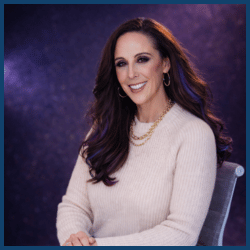
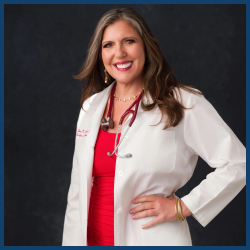
Organizers & Presenters


Presenters





Presentation Schedule
Day One
Session One – Why The Fear of Estrogen?
- New estrogen receptors ( ERalpha66 vs. ERalpha36), what drives “good” to “bad” actions. These set the scene for many of this conference’s presentations.
- Hormones as protectors, what drives rogue behavior, what to test, track, and treat in patients
- Review of 25 human trials prescribing estrogen replacement to ER+ patients
- Breast cancer subtypes: adenocarcinoma, lobular, pure
mucinous, DCIS, triple negative - How to read markers Ki-67, VEGF, etc
- Estrogen Gap Hypothesis and how these guide conversations
Session Two – A Cancer as a Mitochondrial Metabolic Disease**
-
Recognize cancer as primarily a mitochondrial metabolic disease, not a genetic disease
- Understand cancer as defective respiration with compensatory fermentation regardless of cellular or genetic heterogeneity
- Ketogenic metabolic therapy (KMT) as a cost-effective, non-toxic strategy that targets breast cancer cells while protecting normal-cell energy efficiency
Session Three – Metabolic Cause and Treatment of Breast Cancer
- Major metabolic drivers of cancer & effective nutrients
- Adjunctive medications
- Nutrients to select/avoid during radiation and chemo
- Natural strategies for minimizing radiation & chemo effects
- How to protect healthy cells during chemotherapy
Inspirational Interview Series: (non-CME) – Dr. Jill Carnahan
Dr. Jill Carnahan shares her experience overcoming aggressive breast cancer and Crohn’s disease, with practical lessons on resilience, hormone therapies and gut protection during treatment.
Session Four – Conversations to Testing to Treatment Guidelines
- Initiate conversations with breast cancer patients exploring risks vs. benefits of HRT
- Determine appropriate BHRT treatment protocols from 24-hour urine analysis
- Explain estrogen-optimizing pathways using botanicals, nutrients, and hormones
Session Five – Estrogen’s Real Science Part 1
- Human vs equine estrogen in proliferation rates & estrogen receptor targeting
- Criteria for HRT in breast cancer survivors
- Ki-67 markers and pathology parameters
- Three phases of Tamoxifen resistance
Session Six – Iodine Controversies
- Common controversies around high‑dose iodine
- Safe clinical use of Iodine
- Testing for iodine deficiency
- Individualized replacement strategies.
- Functional approaches for thyroid and breast disorders
- Collaborative care with oncologists
Session Seven – 3 Experts – Case Reports: Using HRT in Breast Cancer Patients
- Histories, HRT protocols, and patient progress from three expert case reports
- Clinical implications of HRT in breast cancer patients
- Case-based insights to personalize HRT decisions for breast cancer survivors
Non-CME Q&A
Day Two
Session Eight – Testosterone and Breast Cancer**
- Testosterone’s physiological role and intracrine conversion to estradiol
- The rationale and mechanism for T+AI in implants for breast cancer survivors
- Clinical benefits of T+AI therapy through the analysis of case reports
Session Nine – Estrogen’s Real Science Part 2
- Human vs equine estrogen in proliferation rates & estrogen receptor targeting
- Criteria for HRT in breast cancer survivors
- Ki-67 markers and pathology parameters
- Three phases of Tamoxifen resistance
Session Ten – The Role of Repurposed Drugs in Treating Cancer**
- The role of repurposed drugs for breast cancer and their tiered application
- Strategies to manage chemotherapy‑related adverse effects
- Nutrient safety during chemo/radiation and when to reintroduce supplementation
Session Eleven – A Clinician’s Guide to the Journey
- RGCC and how its testing, tracking, and vaccines help advanced cancer patients thrive
- Use of ozone and whole blood irradiation and dosing in cancer patients
- Case-based insights regarding nutrients, botanicals, and repurposed medications for breast cancer patients
Inspirational Interview Series: (non-CME) – Dr. Jeff Kotulski
Dr. Jeff Kotulski, immunotherapy expert, discusses when and how immunotherapy can make the greatest impact.
Session Twelve – What Drives Recurrence: The Science, The Cases
- TGF‑β1 and dormant tumor cell roles in recurrence
- Botanicals and nutrients that inhibit dormant tumor cells
- Hydroxychloroquine + rapamycin phase 2 trial and mTOR pathway
Session Thirteen – The Progesterone Paradox
- Physiologic and pathophysiologic roles of progesterone in breast tissue and their relevance to cancer risk and progression
- Natural progesterone vs. synthetic progestogens: differential effects on breast cancer biology, receptors, and hormone therapy
- Evidence‑based use of progesterone in high‑risk patients and breast cancer survivors
Session Fourteen – Strategies for T-Cell Upregulation: Evidence-Based Approaches to Boost T-Cell Response in Cancer Patients
- Bioactive food components that enhance T cell function
- Why anthocyanin-rich foods are essential for cancer patients
- The pros and cons of soy and strategies for patients with allergies
Session Fifteen – Case Studies: Breast Cancer Patients and Hormones
- Clinical histories and hormone protocols from multiple expert case reports
- Implications of hormone therapy in breast cancer
- Case insights for individualized hormone management
Non-CME Q&A
** Denotes sessions not included in the Non-CME Professional Level Course
Day 3
Session Sixteen – Breast Cancer Pearls: From Dosing Melatonin to Treating Lymphedema
- Melatonin dosing
- Jordan’s estrogen‑deprivation theory
- Stair‑step hormone strategies and dietary recommendations
- Functional strategies for lymphedema, radiation burns, and kidney protection during chemotherapy
- Tracking spike protein IgG and how to “detoxify” this carcinogen
Session Seventeen – Hormone Testing and Efficacy
- Appropriate hormone testing for breast cancer patients
- Interpreting results for breast cancer patients
- Hormone bases and delivery modes comparisons (including special considerations)
- FSH monitoring to assess estrogen efficacy and tissue protection
- Introduction to using and dosing 2MEO
Inspirational Interview Series: (non-CME) – Dr. Anna Cabeca
Dr. Anna Cabeca addresses vaginal health, intimacy, and hormone considerations during and after breast cancer treatment.
Session Eighteen – Iodine and Breast Cancer Recurrence
- Iodine’s role in modulating estrogen metabolism for breast cancer prevention
- How DIM works with iodine to support estrogen pathways
- Iodine + DIM protocols for recurrence‑risk reduction.
Session Nineteen – What Nutrients Must Be Avoided During Allopathic Cancer Care and When to Restart?
- Nutrients to avoid during radiation/chemotherapy
- Appropriate timing to restart supplementation.
- Recommend protective nutrients for patients undergoing treatment
Session Twenty – Hormones and High‑Risk Cardiac Patients**
- Studies and delivery modes that support safe HRT use in high‑risk cardiac and genetic pro‑coagulatory patients.
- Estrogen’s cardioprotective mechanisms
- Strategies for cardiac protection during chemo
Session Twenty-One – Iodine: The Universal Anticancer Agent
- Therapeutic use of iodine in breast and other cancers
- Individualized dosing
- Testing and treatment duration
- Case reports
** Denotes sessions not included in the Non-CME Professional Level Course
